In this scenario, we have a continuous mediator
,
a continuous outcome
,
and x2 as the effect modifier on
.
The sample size is 50 and there are 3 covariates.
Sample simulated Dataset
dat <-  cma_sampledata(N = 50, L=3, P=3, scenario=1, seed=7)
head(dat$data, n = 3L)
#>           z1         z2         z3           M         x1          x2        x3
#> 1  2.2767428  0.1432685  0.7973699  0.58827130 -0.3556944  2.02334405 -1.477592
#> 2 -1.0893537 -0.0944783  0.4035083  0.01382552  1.0973004  0.86249250 -2.973256
#> 3 -0.6389109  0.2491581 -0.1243989 -0.42344188 -0.9066920 -0.02490949 -1.339762
#>           y
#> 1  1.964451
#> 2 -1.526532
#> 3 -1.305984
dat = dat$data
Fit BKMR Models
let
be a
-by-
matrix containing an exposure mixture comprised of
elements,E.M and E.Y be effect modifiers of
exposure-mediator and exposure-outcome relationship respectively,
,
a vector of outcome data, and
,
a vector of mediator data.
Z.M <- cbind(A,E.M)
Z.Y <- cbind(A,E.Y)
Let Z.M be the exposures and effect modifers
E.M and let Z.Y be the exposures and effect
modifers E.Y, create one more matrix containing the
exposures, effect modifier Z.Y and mediator, precisely in
that order.
Zm.Y <- cbind(Z.Y,m)
NOTE: the last column of the Zm.Y matrix must
be your mediator in order for the functions to work properly.
A <- cbind(dat$z1, dat$z2, dat$z3)
X <- cbind(dat$x1, dat$x2, dat$x3)
y  <- dat$y
m  <- dat$M

E.M <- NULL
E.Y <- dat$x2

Z.M <- cbind(A,E.M)
Z.Y <- cbind(A, E.Y)
Zm.Y <- cbind(Z.Y, m)

set.seed(1)
fit.y <- kmbayes(y=y, Z=Zm.Y, X=X, iter=10000, verbose=TRUE, varsel=FALSE)
#save(fit.y,file="bkmr_y.RData")

set.seed(2)
fit.y.TE <- kmbayes(y=y, Z=Z.Y, X=X, iter=10000, verbose=TRUE, varsel=FALSE)
#save(fit.y.TE,file="bkmr_y_TE.RData")

set.seed(3)
fit.m <- kmbayes(y=m, Z=Z.M, X=X, iter=10000, verbose=TRUE, varsel=FALSE)
#save(fit.m,file="bkmr_m.RData")
Values at which to predict counterfactuals
Mean level of confounders:
We define the change in exposure for which you want to estimate the
mediation effects: in this example, we will consider a change in all
exposures from their 25th to 75th percentiles, fixing age
(E.Y) at testing to its 10th and 90th percentiles. However,
this contrast can be anything.
Note: If modifiers are considered, you should fix the levels of the modifiers
astar <- c(apply(A, 2, quantile, probs=0.25))
a <- c(apply(A, 2, quantile, probs=0.75))

e.y10 = quantile(E.Y, probs=0.1)
e.y90 = quantile(E.Y, probs=0.9)
The index of the MCMC iterations to be used for inference:
sel<-seq(5000,10000,by=10)Estimate TE for BKMR
Estimate the TE for a change in the exposures from to fixing Effect modifier at testing to its 10th percentile or 90th percentile:
e.y10 = quantile(E.Y, probs=0.1)
e.y90 = quantile(E.Y, probs=0.9)

TE.ey10 <- TE.bkmr(a=a, astar=astar, e.y = e.y10, fit.y.TE=fit.y.TE, X.predict=X.predict, alpha=0.05, sel=sel, seed=122)

TE.ey90 <- TE.bkmr(a=a, astar=astar, e.y = e.y90, fit.y.TE=fit.y.TE, X.predict=X.predict, alpha=0.05, sel=sel, seed=122)
Look at the posterior mean, median, and 95% CI for TE:
TE.ey10$est
#>         mean    median     lower     upper         sd
#> TE 0.4414075 0.4427607 0.2848167 0.5929055 0.07907911
TE.ey90$est
#>        mean   median   lower    upper         sd
#> TE 1.339614 1.338395 1.17107 1.494782 0.07832421

plotdf <- as.data.frame(TE.ey10$est)
plotdf["Effect"] <- rownames(plotdf)
ggplot(plotdf, aes(Effect, mean, ymin = lower, ymax = upper))  +
  geom_pointrange(position = position_dodge(width = 0.75))  +  coord_flip()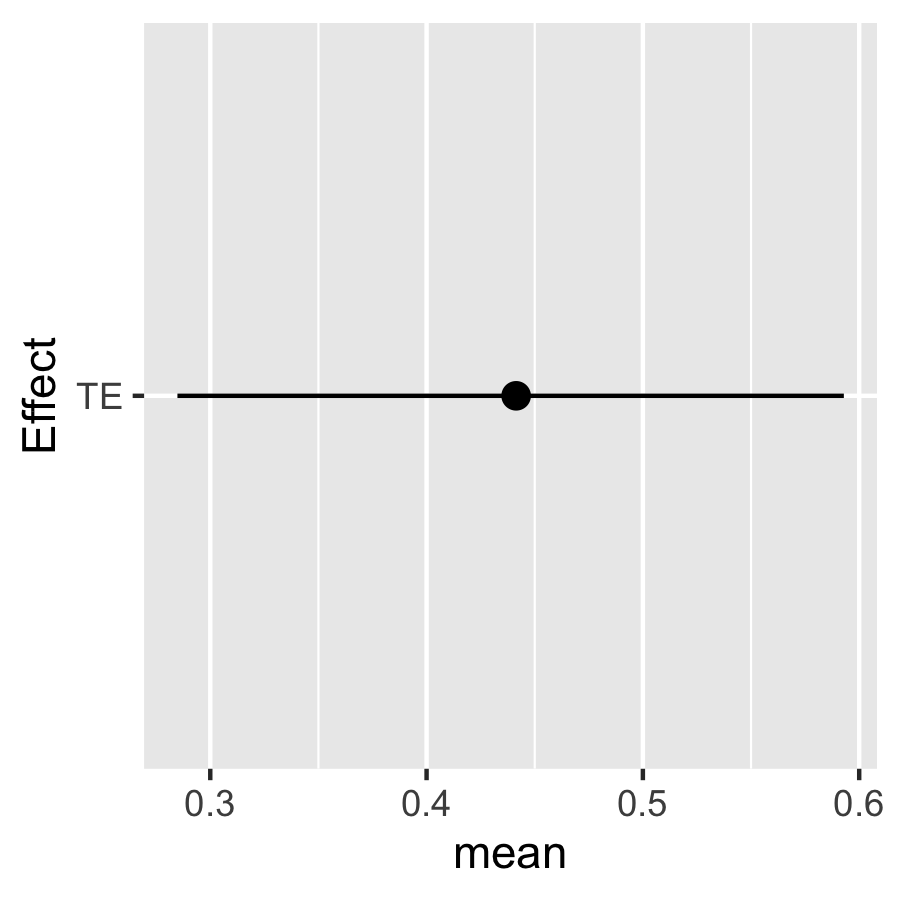
Estimate CDE for BKMR
Estimate the CDE for a change in the exposures from to , fixing the mediator at its 10th, 50th, and 75th percentile and the effect modifier at testing at its 10th percentile:
CDE.ey10 <- CDE.bkmr(a=a, astar=astar, e.y = e.y10, m.quant=c(0.1,.25, 0.5,0.75), fit.y=fit.y, alpha=0.05, sel=sel, seed=777)
#> [1] "Running 4 mediator values for CDE:"
#> [1] "1 out of 4"
#> [1] "2 out of 4"
#> [1] "3 out of 4"
#> [1] "4 out of 4"

CDE.ey90 <- CDE.bkmr(a=a, astar=astar, e.y = e.y90, m.quant=c(0.1,.25, 0.5,0.75), fit.y=fit.y, alpha=0.05, sel=sel, seed=777)
#> [1] "Running 4 mediator values for CDE:"
#> [1] "1 out of 4"
#> [1] "2 out of 4"
#> [1] "3 out of 4"
#> [1] "4 out of 4"
Look at the posterior mean, median, and 95% CI for the CDEs:
CDE.ey10$est
#>             mean    median     lower     upper         sd
#> CDE10% 0.3281490 0.3348591 0.1343525 0.5058129 0.09798879
#> CDE25% 0.3370905 0.3438450 0.1502369 0.5111669 0.09441366
#> CDE50% 0.3505605 0.3589534 0.1608827 0.5232460 0.09380879
#> CDE75% 0.3612455 0.3687880 0.1603481 0.5388214 0.09718429
CDE.ey90$est
#>            mean   median     lower    upper         sd
#> CDE10% 1.220641 1.224680 0.9837519 1.415078 0.10790548
#> CDE25% 1.229732 1.233787 1.0112267 1.413634 0.10027420
#> CDE50% 1.239655 1.244461 1.0452505 1.416089 0.09336095
#> CDE75% 1.244387 1.252115 1.0555353 1.419519 0.09252889
Plotting:
plotdf <- as.data.frame(CDE.ey10$est)
plotdf["Effect"] <- rownames(plotdf)
ggplot(plotdf, aes(Effect, mean, ymin = lower, ymax = upper ))  +
  geom_pointrange(position = position_dodge(width = 0.5))  +  coord_flip()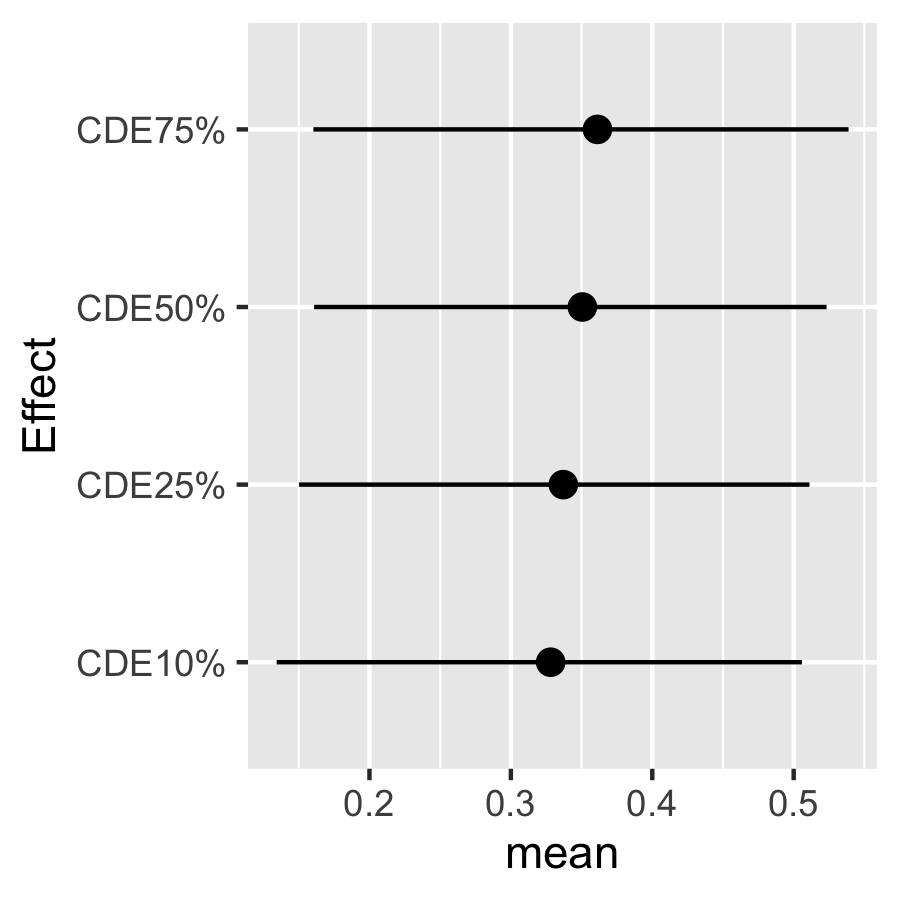
Estimate NDE/NIE for BKMR
Estimate the TE, NDE and NIE for a change in the exposures from to fixing age at testing to its 90th percentile.
Note: this step takes a while to run and will take longer for more
complex BKMR fits, longer sel vectors and larger.
mediationeffects.ey10  <- mediation.bkmr(a=a, astar=astar, e.y = e.y10, fit.m=fit.m, fit.y=fit.y, fit.y.TE=fit.y.TE, X.predict.M=X.predict, X.predict.Y=X.predict, alpha=0.05, sel=sel, seed=22, K=10)

mediationeffects.ey90  <- mediation.bkmr(a=a, astar=astar, e.y = e.y90, fit.m=fit.m, fit.y=fit.y, fit.y.TE=fit.y.TE, X.predict.M=X.predict, X.predict.Y=X.predict, alpha=0.05, sel=sel, seed=22, K=10)
Look at the posterior mean, median, and 95% CI for the TE, NDE, and NIE
mediationeffects.ey10$est
#>               mean     median       lower     upper         sd
#> TE      0.43344519  0.4373605  0.28608048 0.5719413 0.07642777
#> NDE     0.46376164  0.4662025 -0.02268424 0.9612434 0.24502403
#> NIE    -0.03031645 -0.0360115 -0.54497247 0.4376174 0.24559061
#> CDE10%  0.31886211  0.3202047  0.12609272 0.5173728 0.09825198
#> CDE50%  0.34154761  0.3432965  0.15536080 0.5271944 0.09374263
#> CDE75%  0.35179029  0.3559092  0.14178624 0.5365690 0.09660131
mediationeffects.ey90$est
#>              mean     median      lower     upper         sd
#> TE     1.33206315 1.33310908  1.1860711 1.4739473 0.07412271
#> NDE    1.30327228 1.29575422  0.7502507 1.8822087 0.26921873
#> NIE    0.02879087 0.02299106 -0.5259615 0.5433754 0.26874946
#> CDE10% 1.21024791 1.21009273  1.0026922 1.4179148 0.10804486
#> CDE50% 1.23179114 1.23258318  1.0495918 1.4110840 0.09297286
#> CDE75% 1.23695452 1.23410534  1.0502652 1.4193225 0.09199348
Plotting
plotdf <- as.data.frame(mediationeffects.ey10$est)
plotdf["Effect"] <- rownames(plotdf)
ggplot(plotdf, aes(Effect, mean, ymin = lower, ymax = upper ))  +
  geom_pointrange(position = position_dodge(width = 0.5))  + theme(axis.text = element_text(size = 5))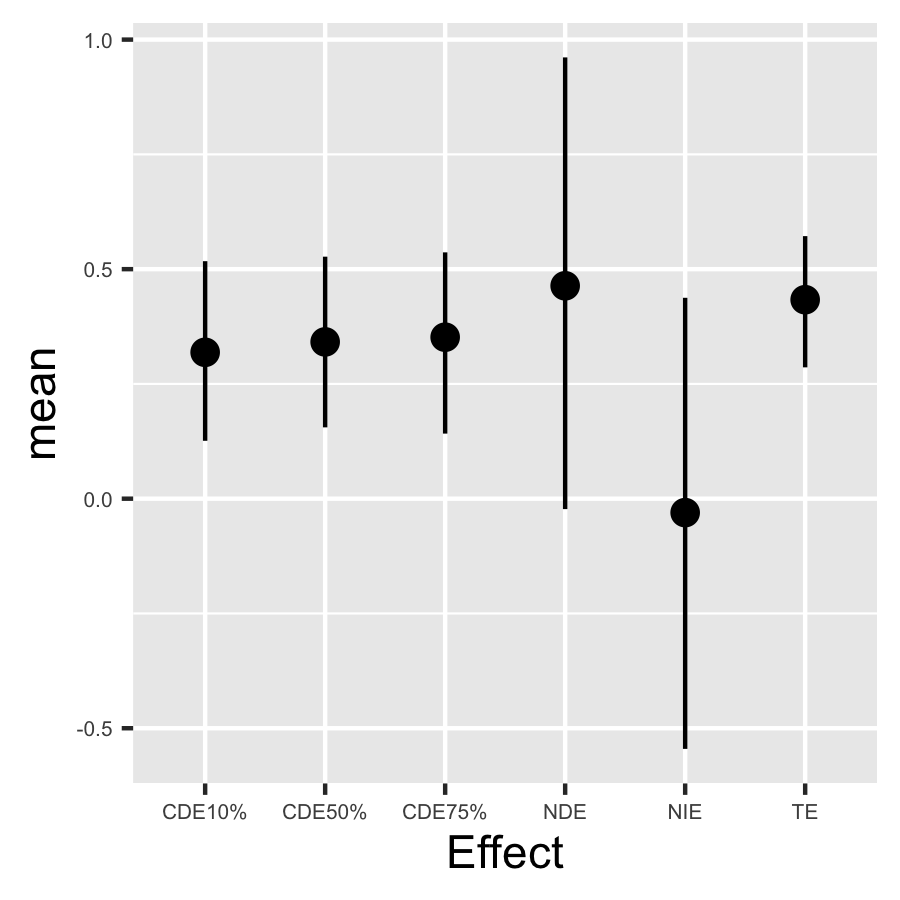
Summary statistics of the predictor-response function
Risk Summary For Totel Effect
riskSummary10 = TERiskSummaries.CMA(fit.TE = fit.y.TE, e.y=e.y10, e.y.name = "E.Y", sel=sel)

p_riskSummary10 <-ggplot(riskSummary10,
       aes(quantile,
           est,
           ymin = est - 1.96 * sd,
           ymax = est + 1.96 * sd)) +
  geom_pointrange() + theme(axis.text = element_text(size = 5))

riskSummary90 = TERiskSummaries.CMA(fit.TE = fit.y.TE, e.y=e.y90, e.y.name = "E.Y", sel=sel)

p_riskSummary90 <- ggplot(riskSummary90,
       aes(quantile,
           est,
           ymin = est - 1.96 * sd,
           ymax = est + 1.96 * sd)) +
  geom_pointrange() + theme(axis.text = element_text(size = 5))

ggarrange(p_riskSummary10, p_riskSummary90, ncol=2, nrow =1)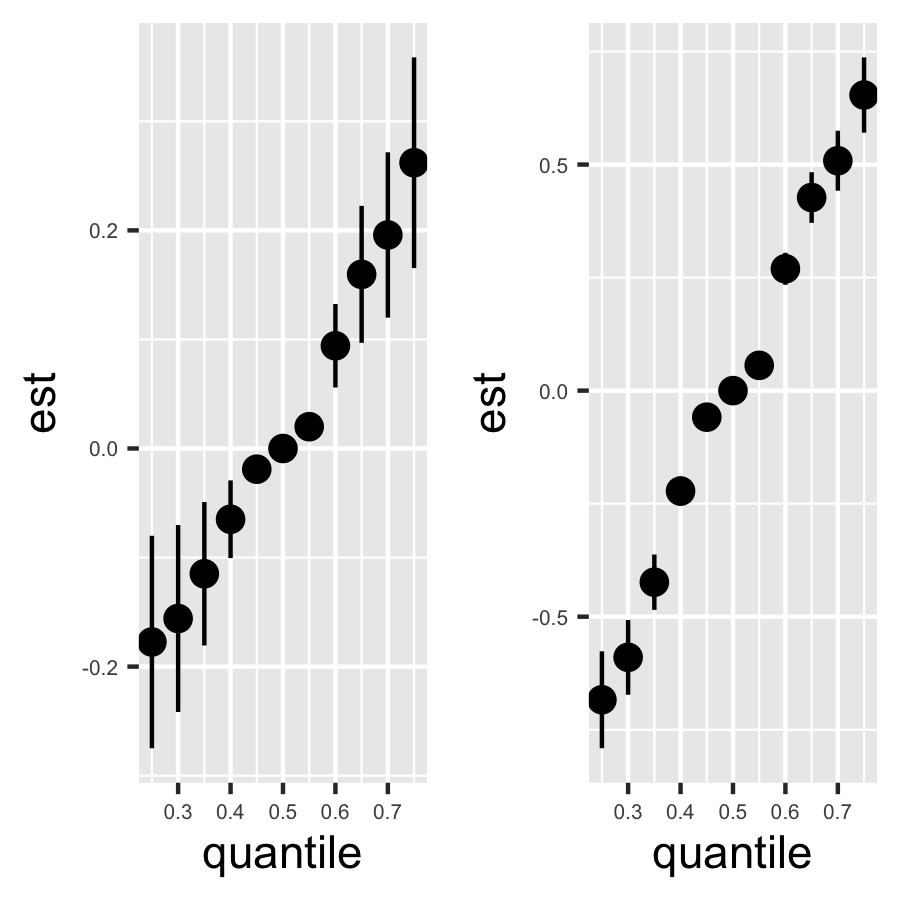
Risk Summary For Controlled Direct Effect
# CDE
CDEriskSummary10 = CDERiskSummaries.CMA(fit.y = fit.y, e.y = e.y10, e.y.name = "E.Y", m.name = "m", sel = sel)

plot_CDErisk10 <- ggplot(CDEriskSummary10, aes(quantile, est, ymin = est - 1.96*sd,  ymax = est + 1.96*sd, col = m)) + theme(legend.position="none") + geom_pointrange(size = 0.5, position = position_dodge(width = 0.2))

CDEriskSummary90 = CDERiskSummaries.CMA(fit.y = fit.y, e.y = e.y90, e.y.name = "E.Y", m.name = "m", sel = sel)

plot_CDErisk90 <- ggplot(CDEriskSummary90, aes(quantile, est, ymin = est - 1.96*sd,  ymax = est + 1.96*sd, col = m)) +
  geom_pointrange(size = 0.5, position = position_dodge(width = 0.2))
ggarrange(plot_CDErisk10, plot_CDErisk90, ncol=2, nrow =1)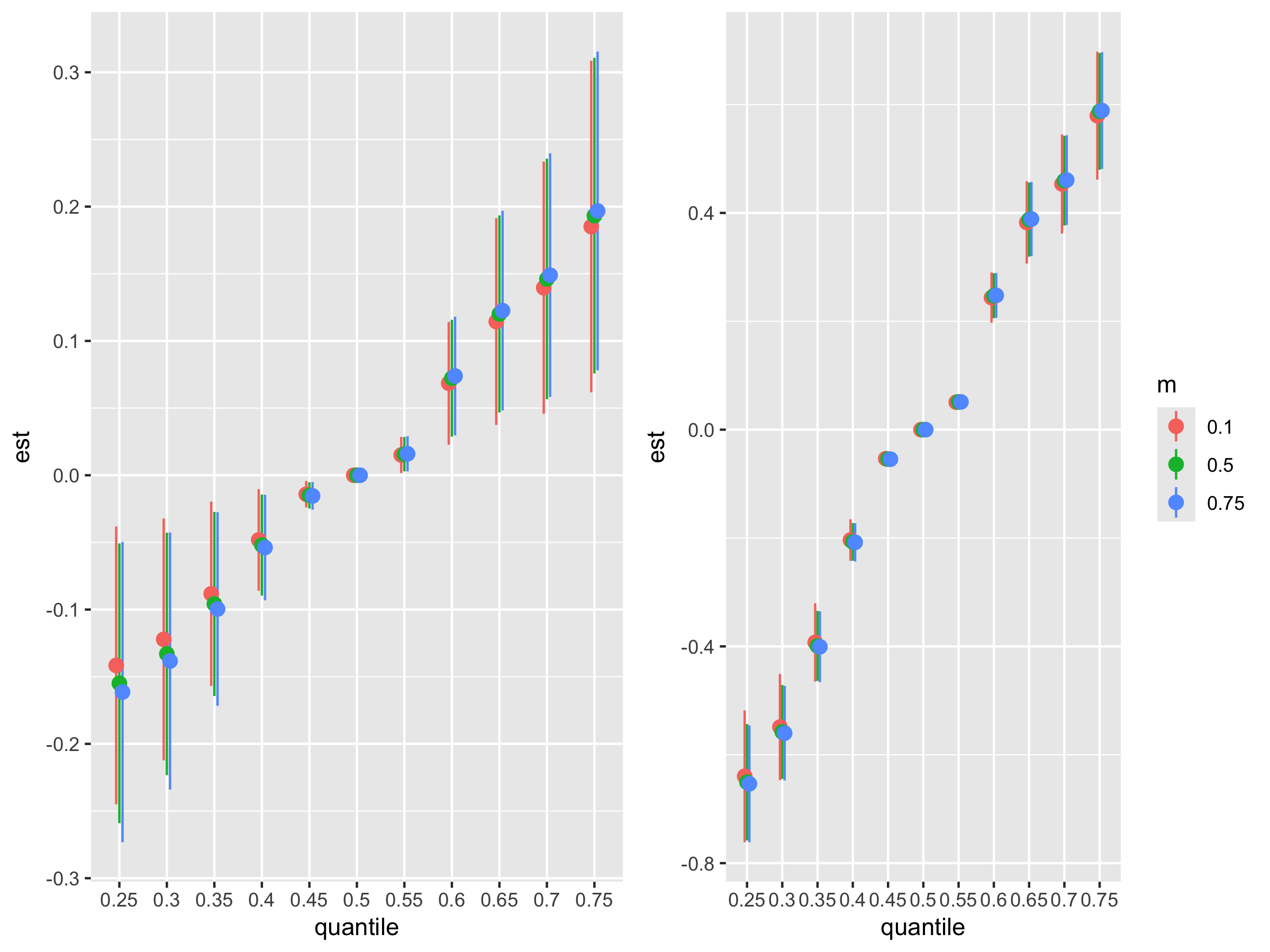
Single-predictor health risks
Total Effect
risks.singvar10 = SingVarRiskSummaries.CMA(BKMRfits = fit.y.TE, which.z = 1:3,
                                           e.y=e.y10, e.y.names="E.Y",
                                           sel=sel)

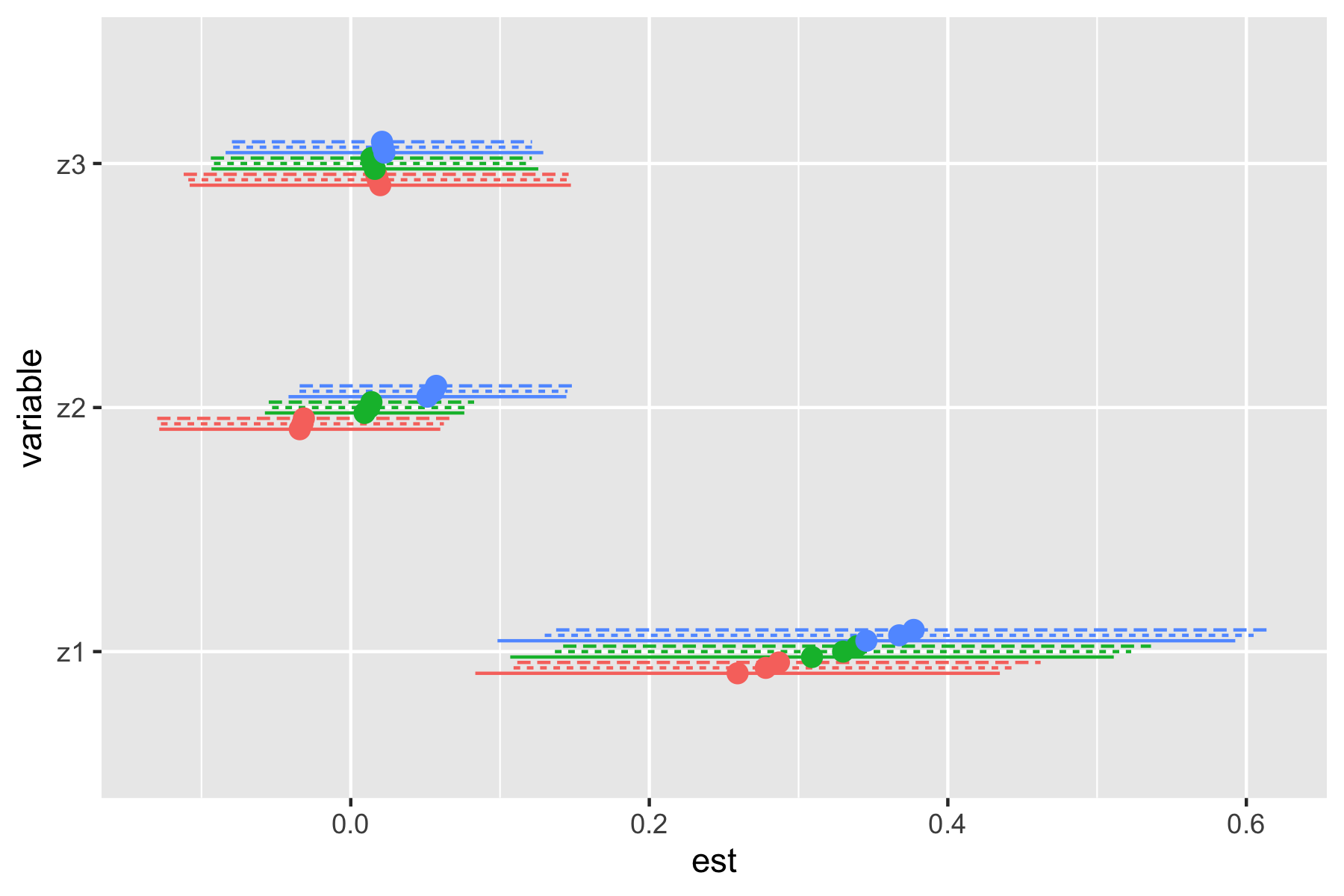
plot_singvar10 <- ggplot(risks.singvar10, aes(variable, est, ymin = est - 1.96*sd, ymax = est + 1.96*sd, col = q.fixed)) + theme(legend.position="none")+
  geom_pointrange(size= .3, position = position_dodge(width = 0.2)) +
  coord_flip()

plot_singvar10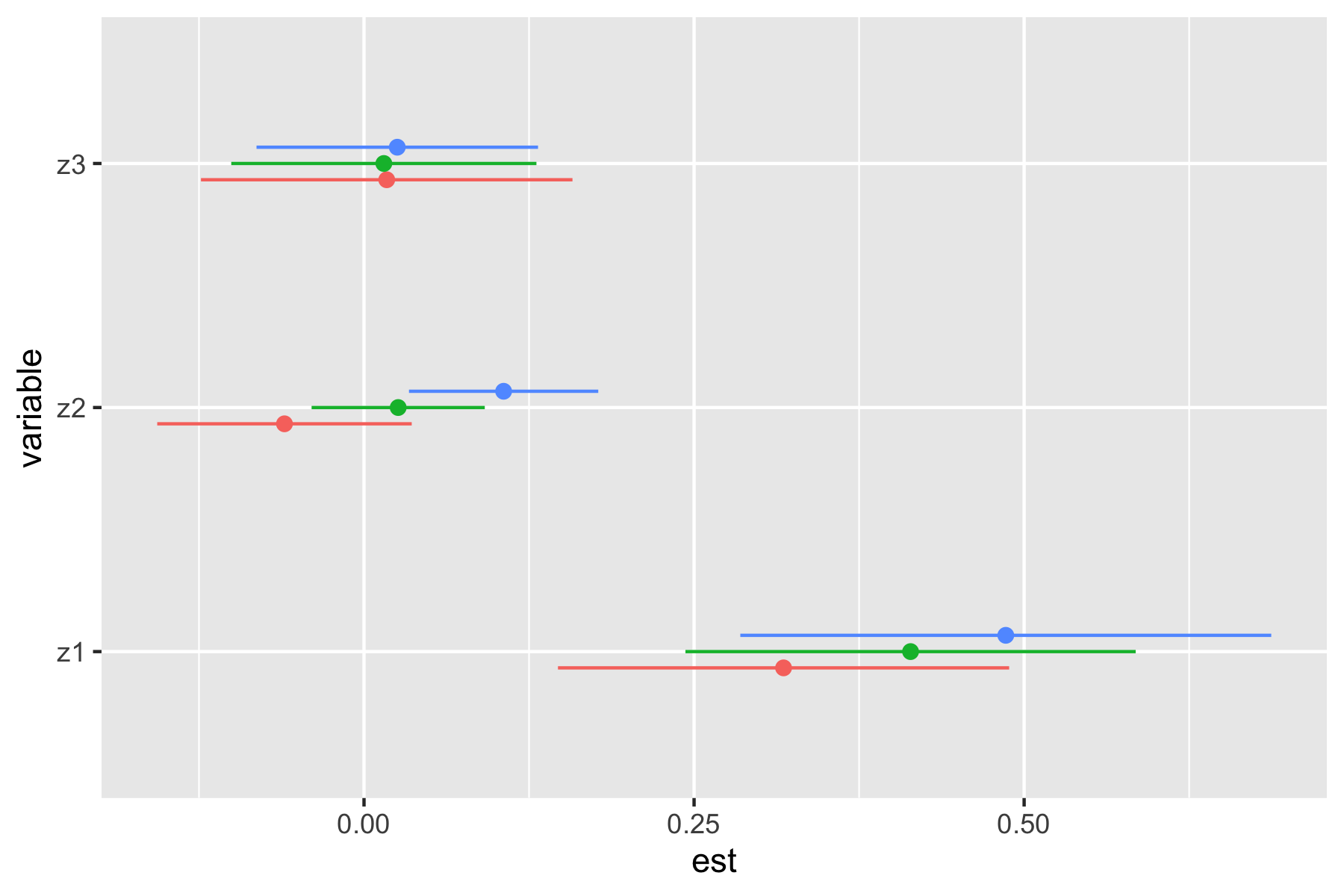
Controlled Direct Effect
# single variable controlled direct effects
CDErisks.singvar10 = CDESingVarRiskSummaries.CMA(BKMRfits = fit.y,
                                           e.y=e.y10, e.y.names="E.Y", m.name = "m",
                                           sel=sel)
plotCDE10 <- ggplot(CDErisks.singvar10, aes(variable, est, ymin = est - 1.96*sd,
                            ymax = est + 1.96*sd, col = q.fixed, linetype = m.fixed)) +
  geom_pointrange(size = 0.5, position = position_dodge(width = 0.2)) +theme(legend.position="none")+
  coord_flip()

plotCDE10